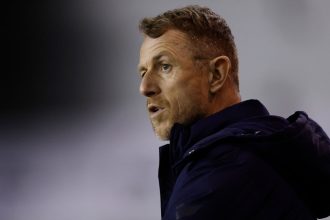
Seated on the team bus next to each other, Rick and Sonny Dykes felt the moment hit them at the exact same time.
Maybe it was their sibling senses or just pure coincidence. Either way, about two hours after TCU, a touchdown underdog, knocked off No. 2 seed Michigan in the College Football Playoff semifinal at the Fiesta Bowl on New Year’s Eve, the two brothers looked at each other and broke out in laughter as the team bus sped away from State Farm Stadium.
They almost simultaneously blurted out the same phrase.
“I still pinch myself,” says Rick, 10 years older than 53-year-old Sonny, TCU’s coach. “There’s never been a team like this in the history of college football.”
In the modern era of the sport, TCU represents the first true Cinderella team to compete in the national championship game. Unranked to start the season and picked to finish seventh in the Big 12 conference, the Horned Frogs (13–1) have stunned the country with rousing comebacks and upsets against the sport’s blueblood powers. They’ve won six games after trailing by double figures in the second half and won three of those with last-second scores. They walloped Oklahoma in October, won at Texas in November and knocked off the Wolverines in last week’s semifinal—and now, they enter Monday’s title bout against defending champion Georgia (14–0).
Only a decade ago, the private school tucked within the bustling cowtown of Fort Worth was classified as a mid-major program and still holds a fraction of the athletic budget of most of its competitors.
On top of it all, the Frogs have produced one of the most improbable one-year turnarounds in the sport’s history. They fired legendary coach Gary Patterson 14 months ago after a 5–7 season and hired a Texan who himself had previously failed as a major college head coach.
So the question is quite a good one: How the hell did Sonny Dykes and TCU end up here?
Outside of TCU’s basketball arena, paces from the gates of its football stadium and square in the middle of the school’s cozy campus, Patterson’s bronze likeness stands tall—his arms folded, his face sporting an intense stare, a whistle draped around his neck and a visor resting atop his head. The statue was erected in 2016 as a way to honor a man who eventually finished his career with 181 wins, 11 bowl victories and six top-10 finishes over a 20-year head-coaching career in Fort Worth.
His run ended in 2021 on Halloween morning, when school officials told Patterson (and his wife, Kelsey, who he brought to the meeting) that they wanted him to step down after the season ended. In disagreement over the move, Patterson resigned immediately.
“If it had come at the end of the season, maybe I would have made a different decision, but after 25 years, how do you … you’ve got to look at that,” says Patterson, now a defensive analyst on staff at TCU’s rival, Texas.
TCU athletic director Jeremiah Donati, who hired Sonny Dykes and fired Patterson, believed the decision needed to happen before the end of the season due to the coaching hiring cycle that has become accelerated by the early signing period and transfer portal era. It was a complicated mess for Donati and an awkward situation for Dykes. He replaced a fired coach of which the school had erected a statue.
“I don’t know that anyone has ever done that,” Dykes says. “It’s very unusual.”
Making it even more uncomfortable: Dykes joined Patterson’s staff as an analyst in 2017 after he was fired by Cal. After four up-and-down seasons on the West Coast, the role was an entry point into coaching in the Dallas–Fort Worth area that eventually helped SMU hire Dykes a year later. His stint at SMU made him an attractive option for TCU.
It’s all come full circle, a cascade of coaching dominoes that elicits a chuckle from Patterson. In a way, he started all of this. “No hard feelings on that kind of stuff with Sonny and [Kelsey],” Patterson says. “This is part of college football. At the end of the day, I’m excited for them.”
Like most coaches who have been in the industry for years, Dykes and Patterson built a relationship. It started with Spike Dykes, Sonny’s father, who coached high school football in West Texas and then presided over Texas Tech for 14 seasons. Patterson recalls visiting Spike’s Tech program a few times. Years later, Sonny paid a visit to one of Patterson’s practices.
“I was appreciative of him for hiring me in 2017,” Sonny says. “I think the world of Coach Patterson. There was nobody invested in a football program more than Gary was invested here. When things ended the way they did and you’re as invested as he was, that’s hard. It’s a tough thing to go through.”
Patterson’s consistent success in Fort Worth turned TCU into an attractive location. When he arrived in Fort Worth in 1998, Patterson recalls team meetings transpiring in an old weight room. There was no indoor practice facility, and, when the school finally built one, it wasn’t air-conditioned.
During Patterson’s time in Fort Worth, including three years as an assistant under Dennis Franchione, TCU participated in four leagues: the Western Athletic, Conference USA, Mountain West and Big 12. The school went from competing against league foes such as New Mexico and Hawai’i to facing conference powerhouses like Texas and Oklahoma.
Through the tumultuous ride, the program won at least one championship in each league despite its size. TCU is one of the smallest schools among the 65 programs in the Power 5 conferences. The school has an enrollment that normally hovers around 10,000 and an athletic budget of roughly $80 million. That’s less than half the budget of in-state giants Texas and Texas A&M and a fraction of middling SEC programs like Arkansas and Ole Miss.
“TCU had to improve some things, and that’s usually what happens when you bring a new guy in,” Patterson says. “You improve some things.”
Since Donati’s time at TCU, the school has invested more than $400 million in facilities, and it recently announced a new Human Performance Center that will feature all the trappings of other high-level football centers across the country.
“This all means that money doesn’t buy championships,” Donati says. “The premium is on coaches and players. Resources are important, but they’re not the only part of the equation. We are well-resourced, but do we have the most? No, but we have enough.”